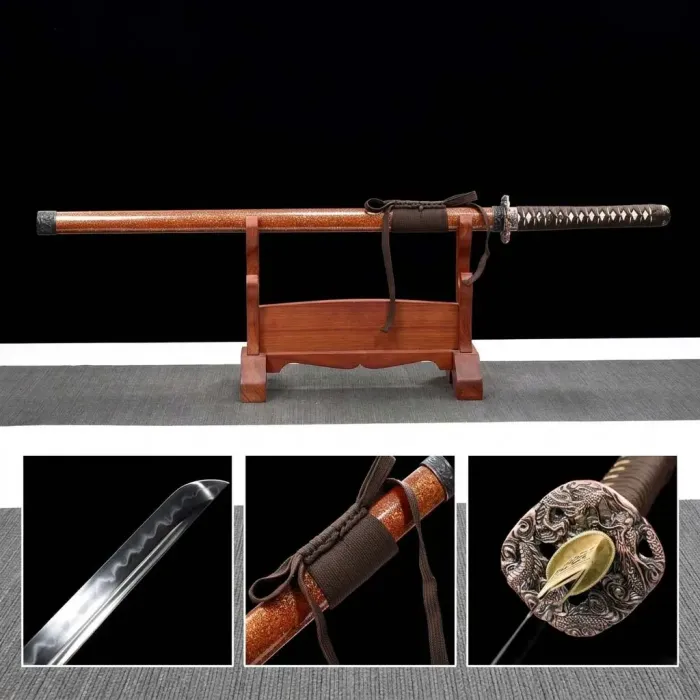
The conventional eastern blade remains a gorgeous display of technique, but assume you seek to show your exclusive design? Adapting your sword is a rewarding journey, allowing you to create a truly distinctive piece. From the hold wrapping and clasp to the handpiece design and temper line, each element offers a chance for tailored look. This survey delves into the space of katana transformations, providing facts for both newcomers and well-versed enthusiasts pursuing to leave their trace on the ancient art of the samurai.
Primary Original Fabrication
For learners hoping to embark on the rewarding journey of classical sword techniques , 1060 steel katanas offer an prime entry point. This defined grade of tool steel achieves a nice compromise between affordability and proficiency. While not as hard as top-tier steels, 1060 permits a workable level of knife work , making it suited for apprentices to develop the foundations of katana upkeep and understand the grace of authentic Japanese weaponry. It’s a great choice for gaining experience without the investment burden of more complex steels.
Grade T10 Swords : Finding Excellence and Budget
To help devotees seeking an authentic saber experience without breaking the capital constraint , T10 material katanas represent a beneficial option. These weapons offer a substantial improvement in resilience compared to middling alternatives, exhibiting fair edge retention and sufficient flexibility for rudimentary slashing techniques. While not rivaling the premium characteristics of superior steels like T100 or folded metal , T10 provides a commendable blend of power and cost-effectiveness , making them a appreciated choice for newcomers and those on a controlled budget .
Surpassing the Keel : Refining Your Armament's Enhancements and Grip
Considering the refined metallic edge is undeniably the central point of a katana, truly enhancing its charm lies in the careful customization of its details and hold. This operation allows users to communicate their unique taste . Think about the vast possibilities: menuki - decorative decorations that introduce visual allure ; the hamon enclosures – often exquisitely sculpted ; the tsuka center itself, wrapped in genuine ito cord ; and the fusa pommel , which can be formed from various elements like valuables or cartilage .
- Pick concepts that echo with you.
- Delve into with multiple substances .
- Value craftsmanship for a continuing impact .
The Allure of the Katana: History, Craftsmanship, and Steel
This historical weapon retains a matchless allure, steeped in generations of Japanese history and heritage . More than merely a contraption of fighting , it's a sign of the soldier ethos – a fusion of expertise and management . Its development spanned various generations, with early cutting tools evolving into the sophisticated curvature and sharp edge we understand today. The creation involved is truly amazing , requiring spans of preparation to complete. The process involves a sophisticated folding of pure iron , creating layers that augment the instrument’s flexibility and slicing ability. Diverse schools of forging originated , each with their specific secrets and styles for achieving the optimal equilibrium and crispness - a truly heavy pursuit.
- Original Katana types
- The function of the traditional blade in soldier culture
- Old-fashioned blacksmithing techniques
Identifying the Perfect Steel for Your Katana Project: 1060 vs. T10
Picking the ideal steel is essentially important for any weapon project, and the selection between 1060 and T10 can be delicate. 1060 is a common sword custom American fabrication, offering a reasonable balance of firmness and resilience, causing it fairly easy to manage. However, T10, a Oriental steel, typically boasts exceptional wear fortitude and can potentially achieve a elevated ultimate hardness, although it can be significantly demanding to control and requires precise heat conditioning. Consider your background and preferred attributes: for a learner, 1060 may be a easier launchpad, while the master smith might seek the augmented traits of T10.
- Convenience of Managing
- Friction
- Definitive Firmness
Accessing Excellence: Progressive Katana Alteration Approaches
Perfecting the skill of sword refinement extends far beyond basic grinding. Serious masters are now examining advanced techniques to truly reveal a blade's hidden potential. This involves intricate work with the heat signature, utilizing specialized compositions for differential annealing and carefully nominating the contour of the shield to optimize balance and quality. Beyond purely functional modifications, artisans are increasingly focused on realizing unparalleled aesthetic magnificence, through complex cutting and layered surfaces that truly transform a katana into a work of art.
Turning Raw Material into Excellence: Creating a 1060 Katana
The journey begins with conventional 1060 material , a durable material far absent the elegant katana it will become . Expert bladesmiths execute a complex process of doubling and forming the primitive steel, repeatedly warming it and beating it to clear impurities and build a stable grain structure. This tedious process, often enduring for periods , builds the required sturdiness and malleability characteristic of a original Japanese cutlery . Later heat manipulations , including methodical hardening and setting , are indispensable to achieve the expected balance of sharpness, durability and beauty .- Folding: Lessens impurities and generates grain structure.
- Forming: Designs the steel into the initial blade form.
- Conditioning: Defines the final hardness and flexibility.
The Lasting Drawing of the Katana: An In-Depth Look at Metal and Personalization
Every time-honored katana continues a striking symbol of Japanese civilization , its fascination far beating mere armaments . Forged from a special steel and periodically featuring intricate patterns , the way of creation itself is a respected art. Beyond the essential craftsmanship, the ability to modify a katana - from the edge marking to the handle wrapping and fastening - permits for a honestly individual embodiment for both supporters and practitioners alike. This fusion of age-old steelwork and boundless personalization brings the katana's continued appeal across the planet .