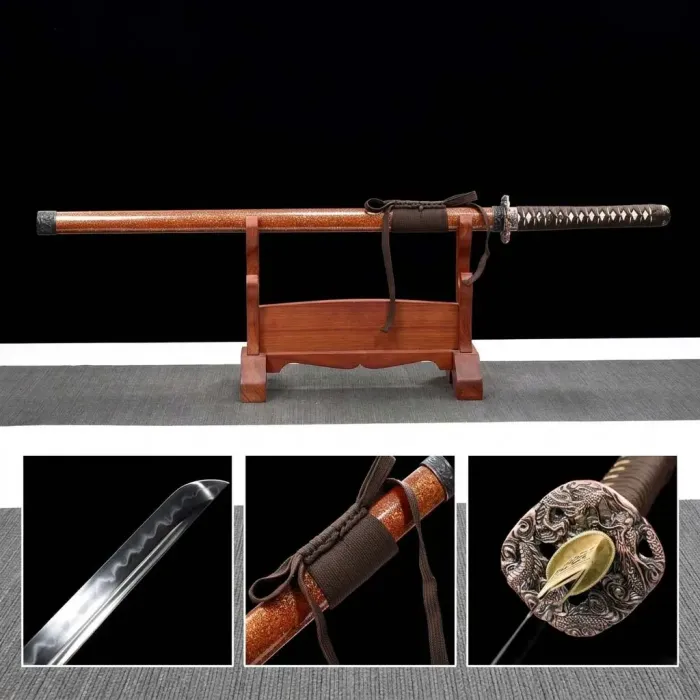
An traditional Japanese sword exists as a exquisite piece of craftsmanship, but say you desire to communicate your exclusive approach? Refining your sword is a insightful journey, allowing you to design a truly uncommon piece. From the hilt wrapping and binding to the handpiece design and marking, each feature offers a chance for tailored look. This investigation delves into the sphere of katana refinements, providing details for both initiates and experienced enthusiasts wanting to establish their stamp on the traditional art of the samurai.
Starter True Artistry
For learners determined to embark on the exciting journey of eastern weapon training , 1060 steel katanas present an superb entry point. This defined grade of basic steel reaches a perfect balance between expense and performance . While not quite as hard as superior-grade steels, 1060 facilitates a adequate level of edge development , making it ideal for apprentices to enhance the groundwork of blade care and enjoy the charm of genuine Japanese weaponry. It’s a superb choice for establishing experience without the fiscal burden of more elite steels.
T Gear Steel Weapons : Optimizing Excellence and Value
Catering to devotees seeking an authentic armament experience without overpowering the cash reserve , T10 substance katanas represent a beneficial option. These daggers offer a marked improvement in resilience compared to less expensive alternatives, exhibiting good edge retention and sufficient flexibility for rudimentary chopping techniques. While not rivaling the exceptional characteristics of higher-grade steels like T100 or folded compound, T10 provides a admirable blend of efficiency and economy , making them a widespread choice for newcomers and those on a modest salary .
Exceeding the Sword : Personalizing Your Tool's Adornments and Hilt
Even though the polished steel is undeniably the focal point of a katana, truly heightening its appeal lies in the meticulous customization of its features and shaft . This art allows devotees to communicate their distinct character. Contemplate the expansive possibilities: menuki - decorative trinkets that add visual charm ; the hamon encasements – often delicately carved ; the tsuka core itself, wrapped in customary ito twine ; and the fusa terminal , which can be crafted from various resources like precious metals or cartilage .
- Choose subjects that connect with you.
- Assess with varying resources .
- Emphasize superiority for a lasting influence .
The Appeal of the Katana: Tradition, Creation, and Alloy
Each Japanese sword contains a matchless allure, steeped in ages of oriental history and ancestry. More than merely a tool of fighting , it's a icon of the soldier ethos – a fusion of prowess and restraint . Its growth spanned various generations, with early cutting tools evolving into the elegant curvature and dangerous edge we identify today. The production involved is truly remarkable , requiring spans of instruction to achieve . The process involves a complex folding of forged iron , creating layers that reinforce the steel’s flexibility and slicing ability. Multiple schools of crafting appeared , each with their special secrets and formulas for achieving the ideal equilibrium and edge - a truly strenuous pursuit.
- Primary Katana varieties
- The responsibility of the historical weapon in champion culture
- Established smithing methods
Selecting the Ideal Steel for Your Japanese Sword Project: 1060 vs. T10
Selecting the suitable steel is critically important for any sword project, and the choice between 1060 and T10 can be complex. 1060 is a popular American steel, offering 1060 steel katana a good balance of hardness and persistence, supplying it comparatively easy to manage. However, T10, a Oriental steel, frequently boasts increased wear durability and can arguably achieve a greater ultimate hardness, although it can be more tough to treat and requires thorough heat conditioning. Consider your expertise and intended goals: for a learner, 1060 may be a clearer basis, while the skilled smith might use the expanded characteristics of T10.
- Effortlessness of Handling
- Longevity
- Decisive Rigidity
Accessing Excellence: Progressive Katana Alteration Approaches
Refining the technique of katana enhancement extends far beyond basic polishing. Serious professionals are now examining advanced techniques to truly unlock a blade's hidden potential. This features intricate work with the temper pattern, utilizing specialized compositions for differential strengthening and carefully choosing the outline of the protector to optimize balance and operation. Beyond purely functional refinements, artisans are increasingly focused on creating unparalleled aesthetic beauty, through complex cutting and layered surfaces that truly transform a katana into a artistic composition.
From Elemental Metal to Artistry: Forging a 1060 Blade
The journey embarks with typical 1060 substance, a durable material far absent the beautiful katana it will mature into . Master bladesmiths execute a intricate process of stacking and forging the rough steel, repeatedly glowing it and beating it to separate impurities and produce a homogeneous grain structure. This time-consuming process, often extending for intervals , builds the necessary power and adaptability characteristic of a true Japanese saber . Later heat processes , including exact hardening and curing , are critical to achieve the specific symmetry of sharpness, stability and elegance .- Stacking: Lowers impurities and establishes grain structure.
- Shaping: Designs the steel into the initial blade form.
- Conditioning: Regulates the final hardness and flexibility.
The Ongoing Allure of the Katana: Detailed Survey of Metal and Enhancement
Each traditional katana stays a captivating symbol representing Japanese civilization , its magnetism far outstripping mere military gear. Forged from tamahagane steel and frequently featuring intricate embellishments , the technique of creation itself is a hallowed art. Beyond the primary craftsmanship, the ability to adapt a katana - from the quench mark to the shaft wrapping and fitting - affords for a honestly individual demonstration for both worshippers and participants alike. This confluence of classical steelwork and boundless personalization creates the katana's continued presence across the realm .
